Why Finding the Right Manufacturing Supplier Can Take up to 13 Weeks, And How to Save up to 5 Weeks!
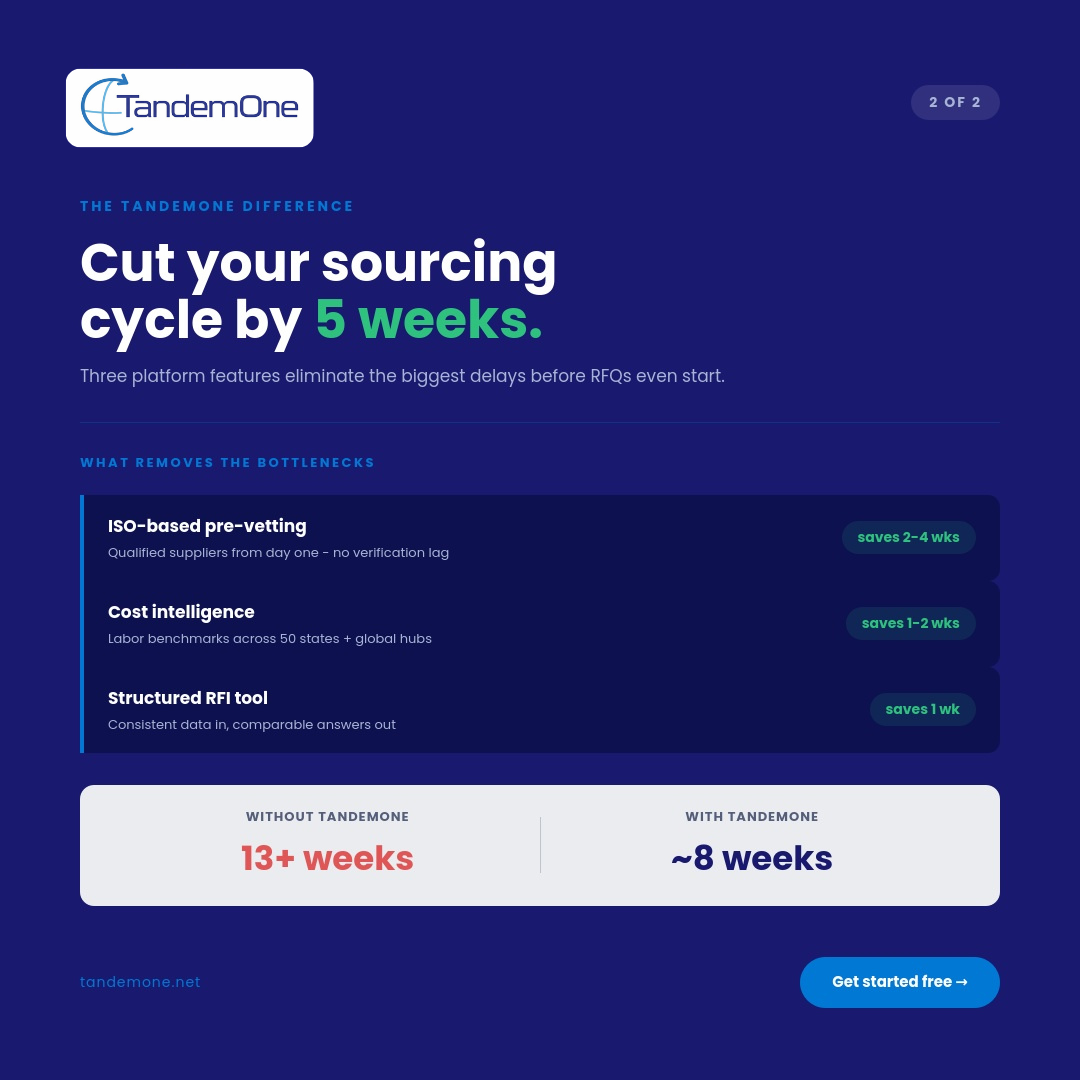
How TandemOne Saves 5 Weeks in Your Supplier Search Process
In manufacturing procurement, speed matters.
But for most teams, finding and validating a new supplier isn’t fast—it’s painfully slow.
While companies often focus on RFQs, negotiations, and contracts, the biggest hidden bottleneck happens before that process even begins:
Supplier discovery and qualification
And in many organizations, that phase alone contributes to a total sourcing cycle of 10–13 weeks or more.
The Reality: Sourcing Cycles Are Longer Than You Think
Procurement isn’t a single step—it’s a multi-stage process that includes:
Identifying needs
Researching suppliers
Vetting capabilities
Running RFQs/RFPs
Negotiating and contracting
Industry frameworks consistently show that supplier research and selection is one of the most time-intensive stages of procurement.
In fact:
Supplier selection and negotiation alone can take several weeks
Teams may spend 6+ weeks just collecting and comparing vendor dataduring sourcing events
Full procurement cycles frequently stretch into multiple months depending on complexity
When you layer in:
Manual supplier searches
Fragmented data across spreadsheets and directories
Back-and-forth qualification emails
Internal alignment before RFQs
…it’s easy to see how “finding the right supplier” can take up to 13 weeks.
Where the Time Actually Goes
The delay isn’t just about “searching”—it’s about validating fit before you can even start sourcing.
1. Supplier Discovery (1–3 weeks)
Searching directories, trade shows, referrals
Limited visibility into real capabilities
2. Supplier Vetting (2–4 weeks)
Capacity, certifications, geography
Back-and-forth communication
3. Pre-RFQ Alignment (1–3 weeks)
Internal stakeholder approvals
Narrowing supplier lists
Only after all of this can teams confidently send RFQs.
4. RFQ to Production (4–8+ weeks)
RFQ issuance and supplier response time
Quote analysis and supplier selection
Negotiation and final approvals
Initial production readiness and onboarding
Even after RFQs go out, time is lost in back-and-forth clarification, misaligned quotes, and onboarding delays—especially when suppliers weren’t fully validated upfront.
The Root Problem: Lack of Visibility
At its core, the issue is simple:
Procurement teams don’t lack suppliers — they lack trusted, structured visibility into supplier capabilities.
Instead of starting with clarity, teams start with:
Incomplete data
Outdated supplier lists
Guesswork
Which leads to:
Over-inviting suppliers
Re-running RFQs
Discovering misfit suppliers too late
How TandemOne Cuts up to 5 Weeks Out of the Process
TandemOne doesn’t just “help you find suppliers faster”—it removes the most time-consuming friction points before RFQs even begin.
The biggest delays in sourcing aren’t caused by a lack of suppliers. They’re caused by uncertainty:
Is this supplier actually qualified?
Are they cost-competitive?
Do we have the right information to even start an RFQ?
TandemOne eliminates that uncertainty across three critical areas:
ISO-Based Pre-Vetting: Know Supplier Quality Upfront
One of the biggest sources of delay is quality validation.
In traditional sourcing, teams spend weeks:
Verifying certifications
Confirming manufacturing capabilities
Assessing compliance and process maturity
TandemOne removes that bottleneck through a robust, ISO-aligned pre-vetting process.
Suppliers on the platform are:
Evaluated against recognized quality standards (e.g., ISO frameworks)
Structured around real manufacturing capabilities—not self-reported fluff
Screened to ensure baseline operational readiness
The result: Buyers start with qualified suppliers, not a long list of unknowns.
Instead of spending weeks validating fit, teams can move straight to evaluation and decision-making.
Cost Intelligence: Stop Guessing Before You Source
Another major delay comes from lack of cost clarity early in the process.
Before RFIs or RFQs, most teams are operating on:
Outdated benchmarks
Internal assumptions
Limited visibility into regional cost differences
This leads to:
Inviting the wrong suppliers
Misaligned expectations
Rework during negotiation
TandemOne’s cost intelligence layer changes that.
With built-in insights into:
Labor rates across all 50 U.S. states
Key global manufacturing hubs (China, India, Mexico)
Energy cost benchmarks
Buyers can:
Quickly narrow down viable regions
Identify cost-competitive suppliers earlier
Enter sourcing events with informed expectations
Instead of guessing, teams start with context—cutting down cycles of correction later.
Structured RFI Tool: Get the Right Information the First Time
Even after finding suppliers, many teams lose time in unstructured information gathering.
Traditional RFIs are often:
Inconsistent across suppliers
Missing critical data
Difficult to compare
Which leads to:
Endless follow-ups
Miscommunication
Delayed RFQs
TandemOne solves this with a structured, standardized RFI workflow.
Buyers can:
Collect consistent capability and qualification data
Ensure all suppliers respond to the same requirements
Easily compare responses side-by-side
The result: No more chasing information or cleaning messy data.
Teams get clear, comparable insights from day one, allowing them to move faster into RFQs with confidence.
The Impact: From 13 Weeks to 8
By removing manual search and early-stage vetting, TandemOne helps teams:
Identify qualified suppliers faster
Reduce back-and-forth validation
Enter RFQs with confidence
The result: Up to 5 weeks saved in the sourcing process
Instead of:
13 weeks to find and qualify suppliers
You get:
~8 weeks to move from need → sourcing-ready
The Bigger Shift: From Search to Strategy
The best procurement teams aren’t just faster—they’re more strategic.
They don’t spend weeks:
Hunting for suppliers
Validating basic information
They spend time:
Driving cost and quality outcomes
Final Thought
Finding the right manufacturing partner shouldn’t take 13 weeks.
But until supplier discovery becomes:
Structured
Transparent
Data-driven
…it will.
TandemOne changes that—by turning supplier search from a bottleneck into a competitive advantage.