If you buy parts for aerospace or automotive programs, you've probably seen all three of these on supplier websites. They're related, but they aren't interchangeable, and asking for the wrong one can either let an unqualified shop through or shut out good suppliers who'd do the job well.
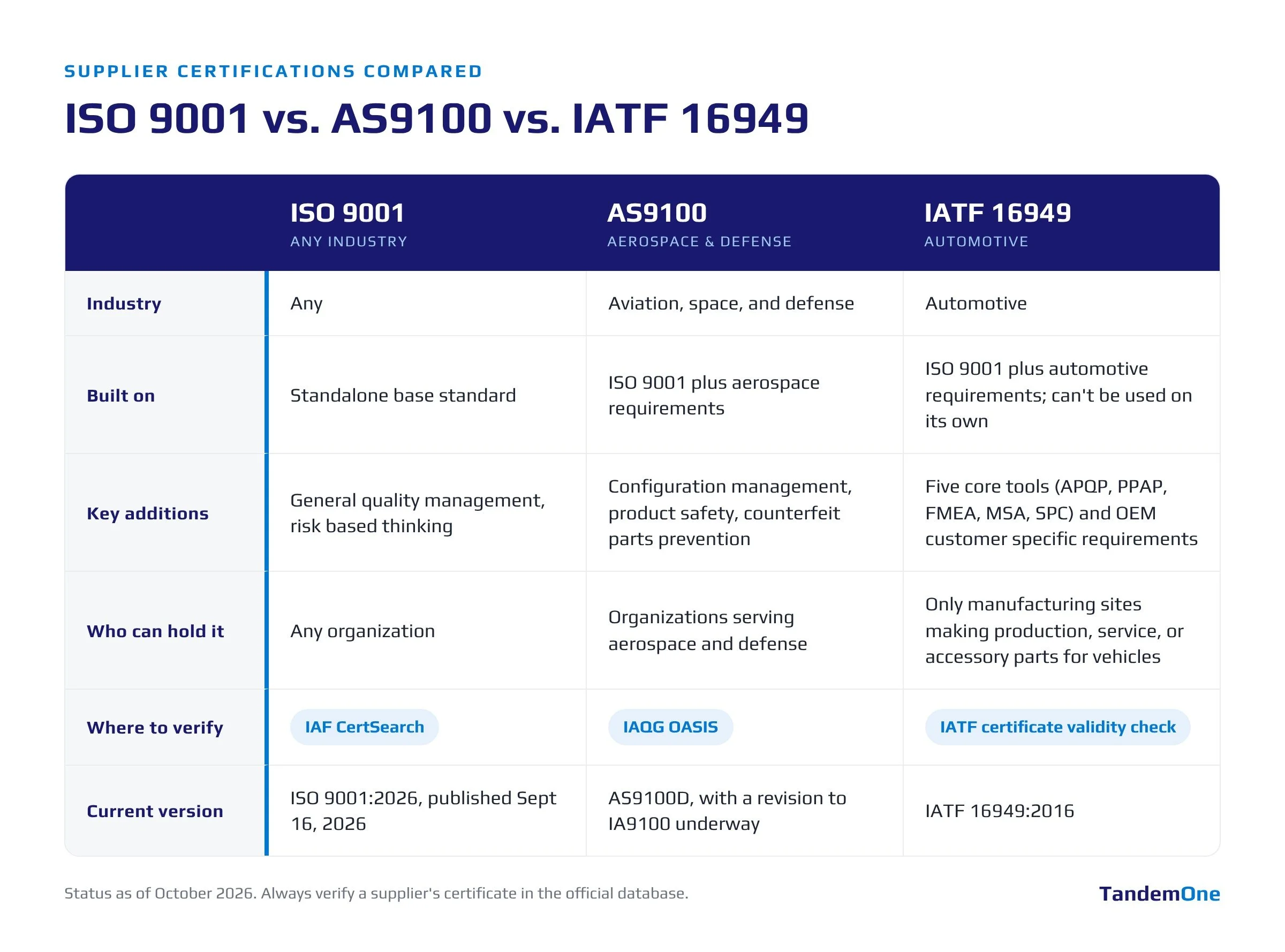
The quick answer: ISO 9001 is the general quality management standard any manufacturer can hold. AS9100 and IATF 16949 are both built on ISO 9001 and add industry requirements on top: AS9100 for aviation, space, and defense, and IATF 16949 for automotive production parts. Ask for the one that matches where your part is going, and verify it in the right database.
There's also a timing wrinkle this year. ISO 9001 was revised in September 2026, and the aerospace standard is in the middle of its own revision and rename. More on both below.
ISO 9001: the foundation
ISO 9001 is the baseline quality management standard for any industry. It tells you a supplier has a documented system for controlling processes, handling nonconformances, and improving over time. It doesn't tell you they're qualified for a specific sector.
The standard was revised this fall. ISO 9001:2026 was published on September 16, 2026, and starts a three year transition period that runs until September 15, 2029. Certificates issued to ISO 9001:2015 stay valid during that window, so a supplier showing a 2015 certificate today isn't a red flag. The revision is an evolution rather than an overhaul, with sharper expectations on risk and explicit climate change considerations. If a supplier's transition is still ahead of them, it's fair to ask about their plan.
For most general industrial parts, ISO 9001 from an accredited certification body is the right ask.
AS9100: aviation, space, and defense
AS9100 takes everything in ISO 9001 and adds requirements the aerospace industry built around reliability and safety. Those include configuration management across a product's life, formal product safety controls, supplier management, and specific provisions to prevent counterfeit parts from entering the supply chain.
The standard is changing. The International Aerospace Quality Group is revising the 9100 series and renaming it IA9100, aligned with the new ISO 9001. As of mid 2026, release was anticipated for late 2026 or early 2027, followed by a transition period. Until then, AS9100D remains the current version.
If your parts are going into an aircraft, a spacecraft, or a defense program, your customer will almost certainly require AS9100. If they're not, requiring it anyway narrows your supplier pool and can raise your costs for no real benefit.
IATF 16949: automotive
IATF 16949 is the automotive industry's quality standard, and it's the strictest of the three about who can hold it. It can't be implemented on its own. It's an extension of ISO 9001. Certification is site specific and limited to locations that manufacture customer specified production, service, or accessory parts for vehicles. Distributors, design centers, and fabless companies aren't eligible on their own.
What sets it apart in practice are the five automotive core tools: APQP for planning product launches, PPAP for proving a process is ready for production, FMEA for identifying failure risks, MSA for validating measurement systems, and SPC for monitoring process stability. On top of the standard, each automaker publishes customer specific requirements that certified suppliers have to meet. Certificates run on a three year cycle with annual surveillance audits.
One useful note for buyers further down the chain: IATF 16949 expects certified companies to develop their own suppliers, with ISO 9001 certification as the minimum starting point. So a Tier 2 or Tier 3 supplier without IATF certification isn't automatically disqualified. Check what your customer's requirements actually say.
How to verify each one
A certificate PDF proves nothing on its own. Each standard has an official place to check it, and it takes a few minutes:
ISO 9001: search the company name or certificate number in IAF CertSearch. Confirm the certificate is current, the certification body is accredited, and the scope covers the processes you're buying. Not every certification body posts every certificate, so if you can't find one, contact the issuing body directly.
AS9100: look the supplier up in IAQG OASIS, the Online Aerospace Supplier Information System. Accredited 9100 series holders are required to be listed there, so a supplier that's missing from OASIS is a finding in itself.
IATF 16949: use the IATF certificate validity check with the supplier's IATF certificate number or Unique Site Identifier. It also shows whether a certificate has been suspended or withdrawn.
While you're there, ask two follow up questions. Which site does the certificate cover? A certificate for one plant doesn't extend to a sister facility. And when is the next surveillance or recertification audit? It tells you how current the picture is. For more on what certification does and doesn't tell you, see our guide to ISO verified suppliers.
Start your search with verified certifications
On TandemOne, every supplier is pre-vetted and ISO verified before buyers see them, and certifications are listed up front on each profile. That means you can filter for the standard your program requires and spend your time comparing capability instead of chasing paperwork. See how TandemOne works, or check our supply chain strategies for more on building a qualified supplier base. If you're still working out tolerances and processes for your part, our manufacturing process guides are a good place to start.